
Architecture
For contributors, operators and curious readers. Explanation.
The tool never writes to OpenStreetMap, and lanes only order the queue. The architecture is built to keep both true.
One process, a few helpers
Section titled “One process, a few helpers”It is a modular monolith. One FastAPI process serves the API, and Caddy serves the web app’s static files and passes API requests on. A worker inside the same process runs the slow jobs. A small model server runs beside it on the same machine. There are no microservices, no message broker and no vector store.
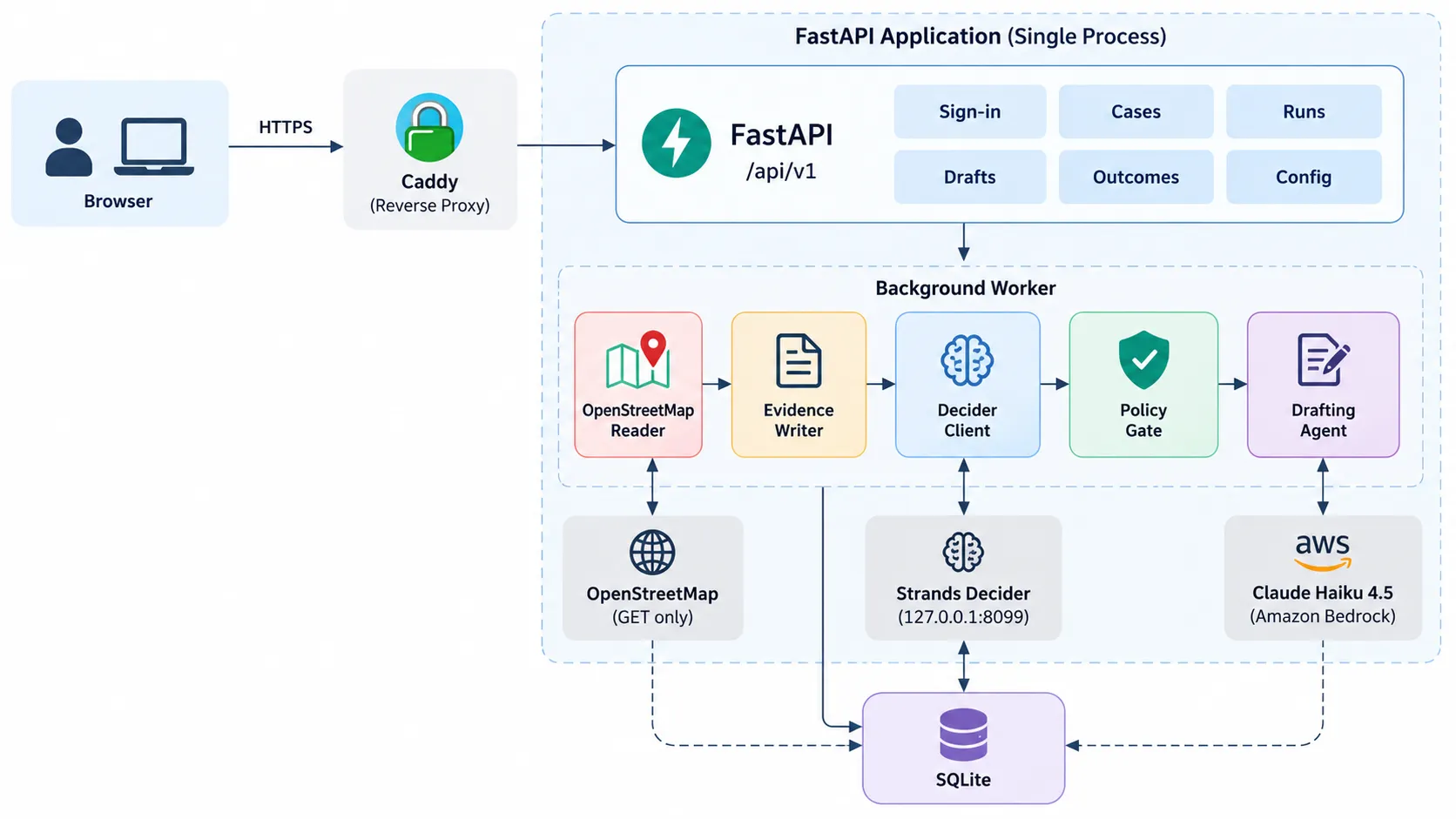
In words, following the figure from left to right and top to bottom:
- The browser talks HTTPS to Caddy, the reverse proxy. Caddy passes requests to the FastAPI application, which serves everything under
/api/v1: sign-in, cases, runs, drafts, outcomes and config. - The API does not do slow work itself. It stores a job in the database, and the worker, which runs inside the same process, picks it up.
- The OpenStreetMap reader makes GET requests to OpenStreetMap and nothing else.
- The evidence writer turns what was read into plain text, coverage first.
- The Decider client sends the ten questions to the Strands Decider, a separate model server that listens on
127.0.0.1:8099. - The policy gate applies the rules, the table and the lane to parsed evidence.
- The drafting agent calls Claude Haiku 4.5 on Amazon Bedrock.
- SQLite holds the results. The worker writes the evidence snapshot, the run and receipt, and the draft. The three outside services never touch the database.
Two details differ from a straight left-to-right reading of the picture. The first four stages run as one analysis job. The drafting agent runs as its own job, and only when a reviewer asks for a draft and the stored decision allows it. The OpenStreetMap server, the Decider and Bedrock are outside services, even though the picture draws them close to the worker.
The parts
Section titled “The parts”| Part | Job |
|---|---|
domain |
The rules, the table, the lanes and the evidence model. Plain Python with no network or disk access. |
adapters/osm |
Reads changesets from OpenStreetMap, or from recorded files in replay mode. GET only, to allowed hosts. |
adapters/decider |
Builds the ten questions, sends them, and checks the answers strictly. It never invents a default. |
adapters/bedrock |
Asks Claude Haiku 4.5 for a draft, checks it, and falls back to a plain template. |
agent |
A Strands agent with one tool, draft_comment, and a hook that checks the stored decision first. |
jobs |
The durable job queue, the worker and the pipeline steps. |
persistence |
Tables, repositories and migrations. Records are never updated or deleted. |
api |
The HTTP contract, sign-in, errors and pagination. |
web |
The single-page app. It shows what the backend computed and computes no lane of its own. |
The web app and the API are separate programs. A contributor tour is in repo tour.
One analysis, step by step
Section titled “One analysis, step by step”- A reviewer adds a changeset id. The API stores a case and queues a job.
- The worker collects the public evidence within a call budget and records how much it saw.
- It renders the evidence as text, with the coverage block first and untrusted fields cleaned.
- It sends one request to the Decider with the ten questions.
- The policy gate applies the rules, the table, the band and the lane, and stores a receipt.
- The reviewer reads the case. A draft is made only when the reviewer asks and the stored decision allows it.
- The reviewer records an outcome. A correction is a new row.
For the reasoning, read how a verdict is made.
In replay mode the tool reads recorded changesets and needs no network, GPU or AWS account. In live mode it reads from OpenStreetMap and uses the live Decider and Bedrock. See replay and live.
Where trust ends
Section titled “Where trust ends”Anything inside evidence text is untrusted. The tool cleans it, shows it as quoted text and never opens a link from it. The model server listens on 127.0.0.1 only. Secrets stay out of code, logs and the web bundle.
Decisions that shaped it
Section titled “Decisions that shaped it”These choices were made on purpose and are settled for the current version. Each row gives the choice and the reason.
| Decision | What was chosen | Why |
|---|---|---|
| Process shape | A modular monolith, with durable jobs kept in the database and run by a worker in the same process | One thing to deploy and debug on one host. A job that is interrupted is picked up again, so no broker is needed. |
| Storage | SQLite, through a SQLAlchemy schema written to be portable | One file is easy to back up and run anywhere. Nothing in the schema ties it to SQLite, so a larger database can replace it later. |
| Finding changesets | A reviewer adds a changeset by its id. The tool does not poll OpenStreetMap | It keeps the number of requests small and polite, and a person chooses what to look at. |
| What the lanes do | Lanes order the queue. Nothing is hidden, closed or posted, and nothing is written to OpenStreetMap | A small model can be wrong with confidence, and flagged queues are noisy. See why lanes only order the queue. |
| How the verdict is formed | One request with ten fixed yes or no questions, then rules and a table on parsed evidence | Every probability is shown and every step is kept in a receipt. A model answer can add caution and never remove it. See how a verdict is made. |
| Front end | A React single-page app built with Vite, TypeScript, Tailwind and TanStack Query | It shows what the backend computed and computes no lane of its own. |
| Hosting | One GPU host on AWS, with a CPU fallback, from one CloudFormation template | The Decider needs a GPU to be quick, and one host is the least to run. See deploy on AWS. |
| Drafting | Claude Haiku 4.5 on Amazon Bedrock, reached through one Strands tool that checks the stored decision first | A draft can only be made when the decision allows it, and a plain template is the fallback. |
| Calibration | The cut points can be refitted from reviewers’ recorded outcomes, and applying a refit is an audited, versioned change | The people who check the readings tune how cautious they are. See calibration. |
| Sign-in | Sign in with OpenStreetMap, asking for the read_prefs scope only |
It proves who a person is and gives the tool no way to write to the map. |
Before the ten-question design, an earlier version asked independent questions and reconciled the answers with fixed code. The ten-question panel replaced that approach for the product.
Map data © OpenStreetMap contributors, under the Open Database Licence. Code under the Apache-2.0 licence. Made by Yogesh.
Changeset Second Opinion is an independent open source tool for OpenStreetMap reviewers. It is not endorsed by, sponsored by or affiliated with the OpenStreetMap Foundation. OpenStreetMap is a trademark of the OpenStreetMap Foundation, used under itstrademark policy.